
Latent Defects Insurance for London Commercial Real Estate
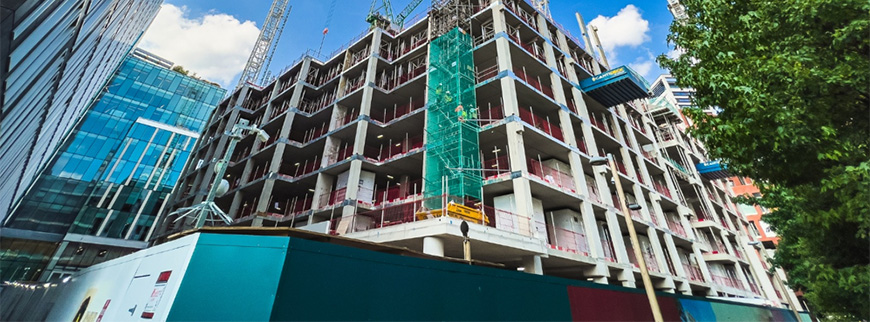
In construction, not every problem is visible at handover. Some faults remain hidden for years, only revealing themselves when cracks appear, water seeps in or structural elements fail. These are known as latent defects, and they can be financially devastating.
Latent Defects Insurance (LDI) also called Structural Defects Insurance or Inherent Defects Insurance, provides long term protection against such hidden structural issues ensuring that repair costs do not fall entirely on the property owner and the capital value of the asset and ongoing revenue streams remain secure.
With contractor insolvencies remaining a constant industry threat and commercial underinsurance risks climbing, LDI, has become an important consideration for institutional investors, commercial landlords and developers
Balancing Collateral Warranties and Latent Defects Insurance
Historically commercial property owners in the UK relied on professional indemnity (PI) policies and collateral warranties. However, relying on them as a sole line of structural defence carries hidden commercial exposures that a first party insurance policy is specifically designed to eliminate:
The burden of proof
To claim on a collateral warranty, one must legally prove negligence or breach of contract, which can be a drawn-out process and lead to highly adversarial battles in the Technology and Construction Court (TCC) racking up legal fees while an asset sits compromised.
The Insolvency trap
If a contractor or structural subcontractor goes bankrupt, a warranty becomes worthless. Professional Indemnity (PI) policies vanish if an insolvent firm fails to renew.
The first-party, no-fault solution
A Latent Defects Insurance policy functions as first party coverage. You do not need to embark on lengthy litigation to prove who made the mistake, you only need to demonstrate that physical damage has occurred due to an inherent design, material or workmanship defect.
Policy Coverage and key commercial extensionsA standard commercial structural warranty provides comprehensive protection for 10 or 12 years from the date of practical completion.
- Foundations & Substructure: Defective pilings, concrete degradation or structural shifting
- The External Envelope: Defective roofing, external cladding and structural glazing
- Water Ingress: Failures in structural waterproofing systems, typically covered from two years onward
- Loss of Rent Insurance: Protects your cash flow if a structural defect forces a commercial tenant to evacuate
- Waiver of Subrogation: Prevents the insurer from suing project partners, maintaining commercial relationships
- Cost optimisation: Premium rates for LDI arranging during the pre-construction phase are generally lower than those for retrospective cover on a completed building, reflecting the reduced information and increased risk uncertainty insurers face once construction has already take place.
- Regulatory Alignment: LDI sits alongside the technical audit requirements introduced under the UK Building Safety Act and the two processes are typically designed to run in parallel during a development’s construction phase.
- Risk management: Standard property insurance typically excludes damage arising from a latent defect, meaning this type of exposure generally falls outside conventional buildings cover.
- Development Finance: LDI is a recognised feature of many UK development finance arrangements and lenders will often expect to see the insurance in place as part of their standard risk requirements for a project.
- Property marketability: LDI policies are typically assignable to a subsequent owner on completion, which can reduce the extent of construction-related risk a buyer needs to separately investigate as part of their due diligence.
- Attracting blue-chip tenants: For developments let on completion, evidence of LDI can form part of the information reviewed by prospective tenants as part of their own due diligence process, alongside other standard building and construction records.
In a shifting market where rebuilding costs remain volatile and supply chain pressures impact construction quality, protecting a real estate portfolio requires a proactive approach. When arranging LDI, timing is important and should be arranged before construction starts or at least before completion.
Disclaimer: The information provided in this article is for general informational and educational purposes only and does not constitute formal finance, legal or regulated insurance advice. Insurance coverage is subject to specific policy terms, conditions and exclusions and underwrite appetites.


